
Etiket Niyazi Dalyanci

The Obama visit is over, discussions about its significance continue
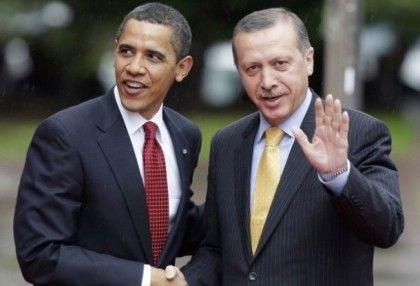
Although the U.S. President Barack Obama gave a variety of messages to make everybody happy during his two-and-a-half day state visit, opinion makers and politicians keep talking about what really was the concrete outcome of his presence in Turkey. Obama paid ample homage to Kemal Ataturk and his secularism in his address to the Turkish National Assembly which definitely made those who oppose the Islamic-oriented policies of the Tayyip Erdogan government happy. The general feeling in these circles was that Obama’s White House will stop encouraging Turkey to become a “moderate Islamic state” as the previous Bush administration did. The next day, when he met with about 100 youngsters in Istanbul, he did not miss to make a point for the pious Turks by saying that he wants to end the meeting before the muezzin calls for evening prayers from the minaret. He made Erdogan happy by hugging him Turkish style and saying, “I was impressed by the prime minister’s leadership when I first met him at the G-20 meeting in London.” He made opposition party leaders happy by seeing them, albeit for only 10 minutes each, separately, including the Ahmet Turk, the leader of the pro-Kurdish Democratic Society Party (DTP) with whom Prime Minister Erdogan even refuses to shake hands with. He made minorities happy by meeting the religious leaders, non-Muslim and Muslim in Istanbul. He made Orthodox Patriarch Bartholomeos happy by receiving him separately, indicating that he recognizes the ecumenical status of the pontiff as the spiritual head of 170 million Christians belonging to Orthodoxy. To make the patriarch even happier he asked publicly from the Turkish government to reopen the Chalki seminary. Realizing that his advice to Turkey to solve its problems with Armenia caused certain annoyance in Azerbaijan, he even called Ilham Aliev, the Azeri president […]
Kurdish speech at the Parliament triggers debate

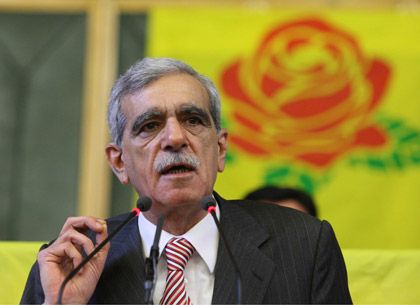
February 21 is the International Mother Tongue Day, said Ahmet Turk, the leader of the Democratic Society Party (DTP) addressing his party’s parliamentary group meeting at the Turkish National Assembly. “Everybody should be able to use his mother tongue freely,” he went on in Turkish. DTP leader then switched on to Kurdish and TRT 3, the official channel that broadcasts from the Turkish Parliament live switched off Turk’s image and voice from the air. Actually Turk, whose party is in a neck-to-neck race in the Kurdish provinces of Turkey with Prime Minister Tayyip Erdogan’s Justice and Development Party (AKP) was making a clever countermove against Erdogan’s recent policies to woo the Kurds. In his election rallies in Diyarbakir and other southeastern Turkish provinces Erdogan has been using the opening of TRT 6, an official television channel broadcasting in Kurdish, saluting the crowds using few Kurdish words like “I wish all the good for you,” etc. Actually, on the day TRT 6 began its Kurdish broadcasts, Erdogan appeared on the screen with a speech that he finished off in Kurdish. Recently, Erdogan announced that his government was in touch with the widow of popular Kurdish singer Ahmet Kaya who died in Paris in exile in 2000, to bring his remains back to Turkey. “If the prime minister is talking in Kurdish why can’t I?” asked Turk. Pointing out that several mayors and even some parliament members were penalized because they spoke in Kurdish, Turk said, “Does that mean that the Kurdish language is free to use for the government members but it is prohibited for the Kurds?” After stopping Turk’s speech in Kurdish, a TRT announcer appeared on the screen saying that using any other language than Turkish under the roof of the parliament is prohibited. “There is no legal sanction […]

1955 riots against minorities on the big screen

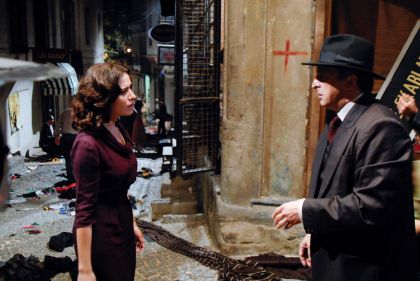
The Turkish public, at least a part of it, had to wait for 50 years to learn what really happened during the pogrom against the Christian inhabitants of Istanbul in September 1955. In 2005 Dilek Guven’s very detailed doctorate thesis on the Septembriana presented at the Bochum University in Germany was published in Turkish. Same year, photographs and documents compiled by the martial law judge retired Admiral Fahri Coker (Tsoker) who served at the court that tried the suspects was also printed and distributed. Tomris Giritlioglu’s film “The Autumn Pain” comes four years later as a cinematographic account of a love affair between a Greek girl from Istanbul and a Turkish boy who comes from a staunchly rightwing and chauvinist but at the same time rich family with a backdrop of Septemvriana. The scenario is based on a novel by Yilmaz Karakoyunlu, a former parliamentarian who has also written an earlier novel about the Wealth Tax levied on Turkey’s non-moslems in 1942. That novel was also put on film by Giritlioglu with the title “Mrs. Salkim’s Diamonds.” As “Mrs. Salkim’s Diamonds” then, “The Autumn Pain” is also hailed now by most of the commentators as an artistic attempt to recognize the injustices done to Turkey’s non-moslem minorities. “The Autumn Pain” completes Giritlioglu’s trilogy which started with “The Other Side of the Water” that again told us a love story between a Greek girl and a Turkish boy as the tragic events of exchange of populations in 1922 between Turkey and Greece unraveled. Ali Acikoz (Atcikoz), one of the commentators on “The Autumn Pain,” points out to the most likely pitfalls in film scenarios structured as a love story at times of social or political turmoil. “Since our generation has witnessed all these events, I did not find any difficulty in […]