
Etiket education

Kids learn how to ask authorities to solve their problems through PAP
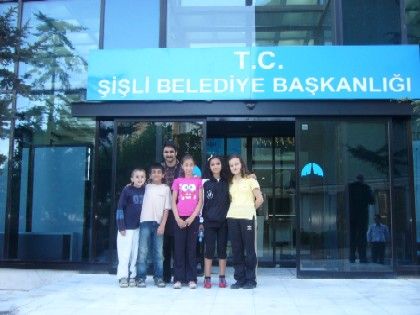
Tunc Karacay Public Achievement Program (PAP) originated in the U.S. in 1990. It was jointly created by Hubert H. Humphrey Social Political Institute and Center for Democracy and Citizenship. In Turkey,Public achievement was realized in 2002. Dr.Serdar Değirmencioğlu, a lecturer on psychology at Arel University in Istanbul, introduced PAP in Turkey recruiting volunteers generally from university students. PAP targets especially schools at low income neighborhoods of Istanbul and Ankara. Each volunteer coaches a group of eight to ten students between the ages 10 to 13. “The aim of the program is to teach children that they have the capability to change things in their lives,” says one of the volunteers. The coaches make sure to leave all the initiative to the children in their group. They let the children discuss and find their own solutions. So much so that, each group of children has a name that they choose themselves by unanimous vote. By only asking questions the coach leads the children to express social and environmental problems that are the most bothering for them in their daily lives. Last year, a group of primary school children participating in the program in Kustepe, decided that their main problem was, “people throwing ashes into garbage containers starting small fires.” “Little Environmental Monsters!” This group which named itself “Little Environmental Monster” was one of the groups consisting of 8 children living in Kuştepe which is one of the poor neighborhoods of Istanbul. After a long discussion they decided that their main problem in the neighborhood was: “people throwing hot ashes into garbage containers causing small fires, because it is dangerous for both environment and children.” Since Kuştepe is a poor neighborhood the problem defined by the children also indicated the level of their life standards where most of the heating is provided […]
Gender discrimination to be expurgated from school textbooks

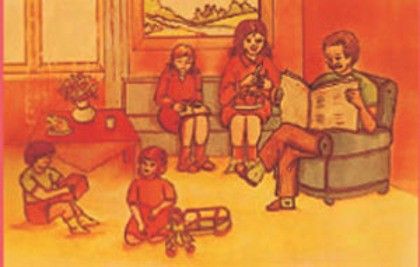
Serdar Cevher Various civil society organizations against sexual discrimination used to organize regular meetings to discuss the classical role of the woman, mostly put forward by family education and supported by national school curricula of young students; but the discussion could not be put on the national agenda for a long time. Although the attitude of the state was highly criticized by many organizations, none of the governments in Turkey, so far, showed any intention to change the curriculum to this effect. But nowadays, mainstream media has taken up the issue.. Distribution of roles in the family Can Dundar from Milliyet newspaper, quoted from a high-school textbook: “Dad provides the family’s livelihood. Mother, as an assistant of the father, prepares meals, cares about children and gives love to them.” He states that things are not so neither in his family, nor in many other families in which women are employed as professionals. Dundar points out that gender discrimination does not only exist in textbooks that introduce social sciences to young people, but also in textbooks of math. He underlines that mathematical problems generally are build around male characters while female figures are only introduced in their capacity to serve men. Content to be changed According to Dundar, Nimet Cubukcu, the first woman who occupied the post of education minister in Turkey, is not satisfied with the current content of textbooks, especially about the distribution of roles in the family. The minister initiated wide ranging work on the content of school textbooks and now Education and Training committee of her ministry is looking into the textbooks used in primary schools, in order to filter out cases of gender discrimination. Distribution of roles in social life There are also some previous studies that dealt with the gender discrimination problem in national education. […]

No museum entrance fee discount for exchange students

Pinar Keles Turkey sometimes appears as a country of contradictions that the students coming from four corners of the world to Turkish universities find hard to grasp.A recent example was brought to light by Istanbul Bilgi University’s History Department and Erasmus Club. Last year Bilgi’s History Department together with the Erasmus Students Club organized a tour of museums and historical sites in Istanbul for the exchange students to have a taste of the rich history of this land. Turkish students were also participating in the expedition. But when the group arrived at the entrance of the first museum, they were faced with a rule that discriminated foreign students from their Turkish friends. Turkish students were allowed to enter showing their student passes issued for museums for 10 TL that gave them access to all museums and historical sites. But foreign students, according to the rule put into practice by the Ministry of Culture and Tourism last year, were to pay 20 TL for each single visit. The rector’s office wrote to the Istanbul office of the ministry to find a remedy for this situation which obviously was neither in the interest of Turkey’s efforts to promote her historical riches nor a hospitable attitude towards foreign students who have chosen Turkey under the student exchange program. The reply was negative. It said, according to Article 5 of the rules! only Turkish citizens are entitled to purchase museum cards. It is understood that the Culture and Tourism Ministry does not observe one of the main universal rules of student exchange under international agreements. According to this rule “Exchange students who continue their studies in countries that are party to this convention are entitled to enjoy all the advantages granted to the students of that country.” Since students coming to Turkey under the […]