
Etiket kurds

Turkey’s winter of openings*

Niyazi Dalyancı “Opening” is the word that has dominated Turkey’s political scene for more than six months now. It seems that the coming winter months would not be able to witness a change of tune unless earthshaking events push this term to the backstage. One of the so-called policy openings concern Turkey’s biggest domestic headache, the Kurdish problem. The other is related to the normalization of relations with Armenia. Although both initiatives were met with optimism in the beginning, six months later they seem even more entangled than ever. It is also interesting to note that both initiatives gained momentum after the new U.S. President Barack Obama visited Turkey in April and delivered an address to the deputies in the Turkish Grand National Assembly.“In the last several years, you have abolished state-security courts and expanded the right to counsel. You have reformed the penal code, and strengthened laws that govern the freedom of the press and assembly. You lifted bans on teaching and broadcasting Kurdish, and the world noted with respect the important signal sent through a new state Kurdish television station,” told Obama to his Turkish interlocutors.According to some Turkish commentators, the U.S. administration has been applying pressure on the Turkish government to solve its Kurdish problem before the American troops pull out of Iraq by 2012 as promised by Obama. American policy-makers are planning to put the Iraqi Kurds under Turkey’s protection against possible attacks from the Sunni and Shiite Arabs after the pull out, according these commentators. In order for the implementation of this policy, Turkey has to pacify the civil strife in its Kurdish provinces neighboring northern Iraq.On August 5, Prime Minister Tayyip Erdogan met with Ahmet Turk, the leader of pro-Kurdish Democratic Society Party (DTP) and a group of deputies. Until then, he had insisted […]
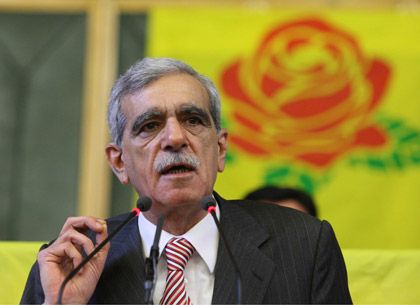
Initiatives for Kurdish problem; are they real or make-believe

Niyazi Dalyanci It all started in May when President Abdullah Gul announced that Turkey has an historical opportunity to solve its age-old problem with its Kurdish citizens. “Good things will happen,” Gul added. Then later during a visit to Damascus, chatting with journalists accompanying him, Gul brought a little more clarification to his statement by saying, “there is a consensus between all the sectors of the society, military and civilian, they are all in cooperation and coordination that has never been achieved before. No one now is trying to undermine what the others are doing.” The euphoria created by Gul’s statements was pushed backstage because of the stormy public debate that a document allegedly written by a colonel at the headquarters of the Turkish General Staff embodied plans to overthrow the Justice and Development Party (AKP) government of Prime Minister Tayyip Erdogan and undermine the Fethullah Gulen movement, an Islamic formation that does not have a legal structure but said to play an increasing political and social role in Turkey. The Kurdish issue came back after the explosive “document” disappeared from the political agenda with no conclusive result. Most recently, Prime Minister Erdogan as he was leaving for an official trip to Damascus and Baghdad announced that there is work underway to solve the Kurdish problem. “A week ago we have initiated work to solve the Kurdish problem with my colleagues at the National Security Council. Then we have assigned the Interior Ministry to contact all the related ministries and departments, like Headquarters of the Chief of Staff, National Intelligence Organization (MIT), etc. They will also contact the parliament members elected from the area. Then they will bring us the results and we will decide on the final steps to be taken,” said Erdogan. “As politicians we are not in […]

Kurdish speech at the Parliament triggers debate

February 21 is the International Mother Tongue Day, said Ahmet Turk, the leader of the Democratic Society Party (DTP) addressing his party’s parliamentary group meeting at the Turkish National Assembly. “Everybody should be able to use his mother tongue freely,” he went on in Turkish. DTP leader then switched on to Kurdish and TRT 3, the official channel that broadcasts from the Turkish Parliament live switched off Turk’s image and voice from the air. Actually Turk, whose party is in a neck-to-neck race in the Kurdish provinces of Turkey with Prime Minister Tayyip Erdogan’s Justice and Development Party (AKP) was making a clever countermove against Erdogan’s recent policies to woo the Kurds. In his election rallies in Diyarbakir and other southeastern Turkish provinces Erdogan has been using the opening of TRT 6, an official television channel broadcasting in Kurdish, saluting the crowds using few Kurdish words like “I wish all the good for you,” etc. Actually, on the day TRT 6 began its Kurdish broadcasts, Erdogan appeared on the screen with a speech that he finished off in Kurdish. Recently, Erdogan announced that his government was in touch with the widow of popular Kurdish singer Ahmet Kaya who died in Paris in exile in 2000, to bring his remains back to Turkey. “If the prime minister is talking in Kurdish why can’t I?” asked Turk. Pointing out that several mayors and even some parliament members were penalized because they spoke in Kurdish, Turk said, “Does that mean that the Kurdish language is free to use for the government members but it is prohibited for the Kurds?” After stopping Turk’s speech in Kurdish, a TRT announcer appeared on the screen saying that using any other language than Turkish under the roof of the parliament is prohibited. “There is no legal sanction […]