HaberVs

HaberVs

Is the spirit of ’68 back in Germany?

Kristin Ofer The spirit of 1968 is back in German universities. After 41 rather quiet years of studying the grandchildren of the former revolutionaries raised their voices again. They are protesting reforms to the country’s university system. But according to Germany’s education minister Anette Schavan the students’ prospects of success are rather low. She stated that the changes will go ahead as planned. Tens of thousands of German students have been demonstrating on the streets of major university towns like Berlin, Leipzig, Hamburg and they are carrying out sit-ins in 27 universities in 23 cities reminiscent of the student upheavals of 1968. The current generation of students was often considered as eager memorizers who are ambitious for their own careers or hedonistic party-animals without any interest in social or political activism. But in the last years German students had to cope with a lot of significant changes. Until 2005 universities in Germany were free. But the so-called university reform imposed tuition fees that range from100 to 500 euros per semester. Actually, most universities charge 500 euros. Compared to many other countries, especially in the Anglo-Saxon world, 500 euros per semester do not seem much. But the German students are questioning the whole principle of paying for education. There are indeed students who are not financially supported by their parents and have trouble to get the required sum of money together. Tobi, a 24-year-old student of dramaturgy is one of them: “I have to work all my free time to afford my living costs and since the adoption of the tuition fee I have to earn 1,000 euros extra per year. It makes me so angry. I can’t even join the demonstrations because I have to work,” he says. Students whose parents do not pay for their studies sometimes spend more […]

Internet censorship threatens Turkey’s reputation

Karen Schewina Instead of looking at their growing magic beans and happy chicken, Farmville users had to read the following message, when they wanted to enter their account on the morning of October 3rd: “After technical analysis and legal evaluation based on the catalog crimes of the Law no 5651, Administrative measure has been taken for this website (zynga.com) according to decision no 421.02.02.2009-272446 dated 02/10/2009 of ‘Telekomünikasyon İletişim Başkanlığı’ (Telecommunications Directorate) TIB.” As the company, which has developed Farmville, YoVille, Vampires, Mafia Wars, as well as a poker application for facebook, was accused of promoting illegal gambling, all of its websites were blocked by the Telecommunications Directorate in an attempt to protect the Turkish citizens. In this case it was not a court issued decision, but an administrative one, so it was not possible to get any statement from the people responsible during the weekend. The decision was highly criticized and caused uproar on the facebook itself, until the site was available again on Sunday night. This example seems to be typical for the strategy of the Telecommunications Directorate dealing with critical content published online: if there is one suspicion being expressed, their reaction is to block the main page as well as all the subdomains, as it happened to WordPress and Google Groups, blogspot and blogger. Not accessible are as well Youporn, The Pirate Bay, Megaupload, Deezer, Virb, Dailymotion, Tagged, Netlog, Slide, CareerBuilder and Alibaba – a complete list of the websites can be found under www.engelliweb.com. “Reporters without borders” states that all in all 1,309 websites have been rendered inaccessible by the Telecommunications Directorate since November 2007, only 270 of them by court order the rest by administrative decision. All of the websites have been blocked according to the Law 5651 on “the organization of online publications […]

Direct Democracy passes through Santral Istanbul

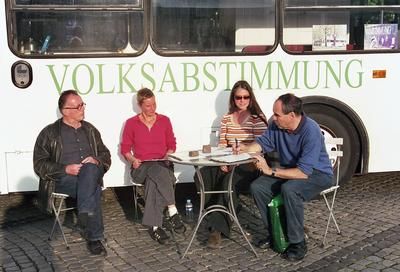
Annika Sehn “The party system is old-fashioned, instead of it there must be an efficient way to voice the questions of individuals,” says Werner Kuppers, the person behind the wheel of the “Omnibus for direct democracy in Germany” that made a stopover at Bilgi’s Santral campus. Johannes Stüttgen, a close friend of the late German artist Joseph Beuys, and an artist himself supports the activists in the bus with ideas, speeches and discussions. “We are driving around with an idea. We are campaigning for the realization of direct democracy on all levels,” explains Stüttgen. The “Omnibus for Direct Democracy in Germany,” as it is officially called, was on a tour of Eastern Europe including Turkey. “Democracy in Motion Tour,” this is how the passengers of the bus call their trip. The main event on the campus was a workshop with the students taking the course called “City and Art.” Following the workshop there was a free discussion with the people on Democracy in Motion Tour. “They were very interested and they were well prepared and had their own thoughts and arguments concerning direct democracy,” Stüttgen said afterwards. To vote just to elect representatives in the legislative assembly is not sufficient for a full democratic system, citizens should be provided with the means to voice their say about concrete issues concerning law and politics, Stüttgen explains. This could be done through popular referendums. Those referendums are already possible in some of the German states. Before a referendum takes place, people have to take initiative and demand that a chance given to them to express their will. A popular referendum is then held on the basis of collection of certain number of signatures and decisions taken in the Bundestag, namely the German Partliament. This procedure aims at direct access to politics for […]

Telephone tapping in Turkey; a measure to intimidate the judiciary?

Niyazi Dalyanci “In fact, our country is under the sway of fear to a large extent. Since its foundation, including the periods when it was run by the military, it did not witness a period of such fear. People coming to visit me are asking, ‘Is this place bugged?’” Suleyman Demirel who has left his mark in Turkish politics for more than 40 years serving both as president and prime minister said addressing a meeting of businessmen in Antalya, last week. The issue was tapping of telephones and other electronic communications between the citizens of Turkey. The problem reached scandal proportions with revelations that judges, prosecutors and even Turkey’s Supreme Court was being bugged. It all began in July 2005 when the Justice and Development Party (AKP) of Prime Minister Tayyip Erdogan passed amendments to the laws governing the functioning of the police, intelligence services and the gendarmerie allowing them to tap telephone conversations without a court order. The same amendment also set up a unit called Telecommunications Directorate (TIB) that was given the task of overseeing the wire tapping both in telephone and internet connections. Since then, telephone conversations and internet mails intercepted by the authorities have been added to the political arsenal of the struggle between the government and the opposition in Turkey. However, the revelations last week that a number of judges and prosecutors, including those serving on Turkey’s Supreme Court have also fallen victim to official eavesdropping led the judicial circles ask the question whether Turkey is heading towards an atmosphere of fear even among the high judges so that they are put under pressure preventing them from functioning properly. Since the law was passed, media organs supporting the Erdogan government regularly printed the contents of telephone conversations leaked to them by unknown sources, between defendants […]

When Journalists Get Too Cozy with the Drug Industry

Aslı TUNÇ In the midst of the swine flu epidemic caused by H1N1 influenza virus, Novartis, a Swiss-based pharmaceutical company, invited a coterie of Turkish journalists to South Africa. The journalists from the dailies, Hürriyet, Radikal and Zaman enjoyed the “hospitality” of the drug company for three days in November. As ordinary readers we learned afterwards that Novartis had briefed them about the company’s “medical breakthroughs” in vaccination of malaria and tried to promote its products, activities and services in Africa. During the journalists’ trip to South Africa, not a single reporter or columnist asked a question on the company’s vaccination policies on swine flu or even mentioned the major pandemic hitting the world and Turkey. The Turkish journalists only indicated in their newspapers that they learned a lot about Novartis’s successes around the world and they got very impressed by the company’s activities. When asked on several TV channels, they declined to answer the question about who paid the expenses of the trip. This gave me a strong impression that this had been an all-expenses-paid trip. Also it made me wonder how many of the journalists in this country would have the courage and integrity to say no to those trips in the future.It is not surprising that pharmaceutical companies work really hard to get their message out to the public and physicians through advertisements. However, there are also well-known ethical guidelines on journalistic integrity and independence when it comes to expenses-paid trips unless they are the only way to cover a significant event. For instance, in BBC editorial guidelines, it indicates that journalists should avoid conflicts of interest, real or perceived, remain free of associations and activities that may compromise integrity or damage credibility and refuse gifts, favors, fees, free travel and special treatment, and shun secondary employment, […]

The political controversy over the 11th International Istanbul Biennial

Fabienne Rozier “How do you reconcile Brecht and the biggest capitalist industrial group in Turkey? » This was the political question that immediately made Istanbul’s 11th Biennial controversial.“What Keeps Mankind Alive?”, the title of the Biennial this year, sounds like a call for reflection and, above all, critical thinking to the visitor. This is not a coincidence; the title of a Bertolt Brecht song has been chosen as the guiding principle. In the same way as it was used by European leftist movements in the 1970’s, the Marxist playwright’s work seems to be an ultimate reference for the curators, the Croatian collective WHW (“Who How For Whom”), a non-profit organization for visual culture dealing with relevant social issues. Quotations from Brecht, prominently displayed in the exhibit, certainly have a resonance in these contemporary times of economical crisis which have provoked a renewal of criticism against neoliberal hegemony and capitalism.“We have to stop pretending that art is a free space, independent of networks of capital and power” explains the conceptual framework of the 11th International Istanbul Biennial. Although there is no doubt that it is politically instructive for the audience, ”The opening ceremony was followed by protest of the small group of activists. Their revolt was directed against contradictory fact that Biennial of contemporary arts, which is lead by idea of political and social engagement of art, is realized with the money coming from private capital. Girls from WHW in an informal talk supported the activists, but they stressed that the exhibition has to be opened » according to the website labculture.org, which provides an up-to-the-minute information about the cultural sector in 50 countries. Indeed, the opening ceremony was depicted by the activists of Resistanbul as an “absurd cacophony of “radical” statements” where “sponsors, bodyguards, and ministers with fake smiles and […]

“What are these pictures stuck up on the walls?”

Piotr ZarębaSarkis, a world famous Turkish artist, thinks this would be the first question, people will ask about his new exhibition Site, open to visitors in Istanbul Modern gallery until January 10. “These are images captured from my past exhibitions held since 19’/70s at museums, contemporary art centers and galleries in different cities,” explains the artist.Sarkis Zabunyan, known as Sarkis, is a Turkish-born Armenian artist. After studying at St. Michel French High School in Istanbul and making degree at Mimar Sinan University he won Paris Young Artists Biennale Prize in 1962 and moved to Paris. In his works of art Sarkis uses photography, installations, watercolor and video. He brings together art and cinema with the mystical traditions of the East.Site is a retrospective exhibition of Sarkis’ last four decades of work. The most significant and dominating part of it are photographs of artist’s former exhibitions (shot by him) and other pictures (landscapes and portraits). They are placed in interiors of gallery like posters on walls in a city environment. “This is an expression – an act – that originates out of desire to blend museum and street with each other,” says Sarkis. Posters are perceived like something new, current, and Sarkis wants to transfer the feelings of his old exhibitions to the present and to give them a trait of newness. He finds them still alive and his aim is to meet all important stages of his career in one place. We can witness almost hundreds of photos selected by the artist from about twenty thousand images. Some of them are incomprehensible for many people, but according to Sarkis, the important thing is to be open-minded and create one’s own perception. “It is like collages in visual arts, like a plot in literature, like leaping from one place to another.”Photographs […]

“Lost in consumption”

Karen Schewina Since I arrived in Turkey, I have this nightmare: I open the fridge, which has turned into some strange kind of biotope for obnoxious organisms. The smell is breathtaking, and I can hardly identify the things I have put in after the last visit in the nearby supermarket, as everything is covered with a thick layer of mould. I remember that entering a Turkish supermarket for the first time, passing the shelves, I felt lost. Not only because I didn’t know what to buy, but also because I was amazed with the big amounts of food, I was suddenly supposed to take home. I spent lots of time walking up and down, looking at the people instead, what they were choosing, in which tone they were talking to the cashier, how many plastic bags they were using to carry their new purchases. In my earlier stays abroad, I had already gained the experience that visiting a supermarket in a foreign country can be the first step to get to know a foreign culture: apart from the fact that it´s the perfect place to learn and practice vocabulary, you learn a lot about the new environment, you are finding yourself in. I have to admit that I have never seen a 15-egg carton or a 10-liter flagon of fabric conditioner before, not speaking of a 1-liter shampoo bottle, which gives me trouble every time I want to hold it in one wet hand – the next time I will just fill it in the nice and handy 330 ml shampoo bottle I brought from Germany.I concluded that nobody living on his or her own can afford to buy these big amounts of merchandise, so I assume that living in your own apartment in a dormitory or renting a single […]

A first in Turkey: Media demands army chief to resign

Niyazi Dalyancı For the first time in Turkey demands for the resignation of an army chief was publicly voiced this week after the news that the original copy of the so-called “Action Plan” to topple the government of Prime Minister Tayyip Erdogan has been received by the public prosecutors, hit the newspaper headlines. Chief Istanbul Prosecutor Turan Colakkadi confirmed that the original copy of the plan which was allegedly drafted at the headquarters of Turkey’s General Staff was posted by an unidentified informer who is said to be a high-ranking officer. The action plan topped the political agenda in Turkey in June when it was published by the Taraf newspaper leading to a heated debate over the role of the army in politics. However, the prosecutors at that time said that they only had a photocopy of the document making it impossible to establish whether it was fake or real. It was again Taraf that published the informer’s letter and broke the news that the original copy of the action plan was in the hands of Istanbul prosecutors. The newspaper has been the source of many such revelations leading to allegations that the government is using it as a medium to leak secret information mainly against the army. The action plan signed by Col. Dursun Cicek, contained measures such as planting weapons at houses used by the Fethullah Gulen sect, which is a politically and financially powerful Islamic sect supporting the Erdogan government, and other steps to discredit the Justice and Development Party (AKP) of the prime minister. Col. Cicek was questioned by the prosecutors during a brief detention but was released later. Turkey’s Chief of Staff Gen. Ilker Basbug described the document “as a piece of paper” and vehemently denied that it came out of his headquarters. He demanded […]

DAT: Risky business with dolphins

Johanna Holm Proponents claim Dolphin Assisted Therapy (DAT) can help people to ease their mental and physical problems, while the opponents argue that there is no medical proof for this claim and DAT poses serious questions and risks. DAT, is a therapy form offered mainly to children who have mental or physical disorders. Ümit Demir, the program and activity coordinator of Istanbul Dolphinarium believes DAT is a useful method which can help children to reduce the symptoms of certain mental and physical disorders and enhance the healing process. Dolphin assisted therapy was born in the 1970’s in the United States and because of its appeal for people suffering from a wide range of medical disorders quickly became an expanding business sector all over the world. The advocates of DAT argue that it is useful for the therapy of mental and physical problems, such as Down’s syndrome, autism, ADHD (Attention Deficity Hyperactivity Disorder), neurological disorders, depression and even AIDS or cancer. Demir explains that in Istanbul Dolphinarium, where they offer dolphin assisted therapy for handicapped children, there has been many success stories. He especially remembers a child who had Down’s syndrome and was not able to walk or talk. After the sessions with dolphins the child could do both. However, Demir says that they never guarantee one hundred per cent healing. Dolphin assisted therapy, instead of actually healing the handicapped, may stop the disease from developing and ease the symptoms, he claims. For the critics of DAT he says, “Some people may have over exaggerated about DAT and when the miracle healing does not happen, they feel betrayed.” In what ways dolphins can help people overcome their disabilities? Theories suggest that dolphins create ultrasonic waves that penetrate into the soft tissues and fluids of the body. Demir says these waves affect […]

Kadıköy’de tıraş

İşvecan Özen Traş. Gayr-ı resmi stand-up. Sinandülger. Avam, politik, komik. Moda Sanat Tiyatrosu. Bunlar yazıyor oyunun gazetedeki tanıtımında. Hiçbir fikrim yok ne olduğu hakkında. Tiyatro salonunun kapısının önünde “bir elin parmaklarını geçmez” deyimini yerine getirecek dört izleyici adayıyız. Bir kadın salonun ahşap kapısını açıp bizi içeri buyur ediyor. Salon küçük. 60 kadar koltuk var. Önden üçüncü sıranın ortalarına oturuyorum. Arkamda 30’larında iki genç delikanlı; biraz garipsiyorum onları. Lig maçlarının olduğu bir günde ve saatte, iki erkeğin beraber bir tiyatroya gelmesini… Uzun boylu olan diğerine “Senin için tiyatro kapattım bak” diyor. Işıkların sönmesini, tiyatrocunun sahnede belirmesini beklerken, afişteki o “ürkünç” adam, Sinan Dülger giriyor salona. Salona diyorum çünkü girdiği kapı bizle, yani izleyicilerle aynı: “Merhaba! Geciken iki kişi varmış. Telefon etmişler. Onları beklememiz gerekiyor” diyor. Ve sahnenin tam ortasındaki tabureye oturuyor. Salonda o ana kadar dört kişi olduğumuza göre gelen iki kişinin, toplam “kitle”nin üçte biri olduğu gerçeğini düşünerek bekliyoruz. Bu arada sahnenin solundaki ahşap masanın üstünde biri su dolu iki rakı kadehi, sigara ve kül tablası olduğunu fark ediyorum. “Ne bekliyorsunuz oyundan” diye soruyor Dülger. Şaşırıyoruz. “Oyuncu oynar, seyirci izler” diye öğretmişler bize ne de olsa. Cevabı kendi veriyor: “Daha önce bazı seyirciler Sinan’ın yaptığı esprileri başkası yapsa gülmekten kırılırdık demiş. Hayır! Burada berber benim, traşı da ben yaparım.” Seyirci-oyuncu sohbeti koyulaşmışken geciken iki kişi geliyor nihayet. Oyunun başladığını Dülger’in ses tonunun, hareketlerinin değişmesiyle fark ediyoruz. Çünkü salon kararmıyor; bütün ışıklar açık. Göz teması var, bütünüyle sivil. “Bu memlekette herkes traş yapar” diyor. İnce dokunuşlarla, ölçülü ustura hareketleriyle giriyor “tıraş”a. Otoriteyi, askeri, hükümeti eleştiriyor. Daha iki yaşında resim yapmaya başlayan, ilk sergisini üç yaşında Amerika’da açan ve bunu CV’sinin en başına yazan dahi Türk ressamın trajikomik durumundan tutun, her Türk çocuğuna ilkokul çağlarında öğretilen dogmatik bilgilere kadar gözden kaçırdığımız veya sırtımızı döndüğümüz konuları mizahla harmanlayarak kafamıza vuruyor. “Çağımızın suçunun ortağı” […]

17th Conference of Journalists on EU-Turkey held in Santral Istanbul

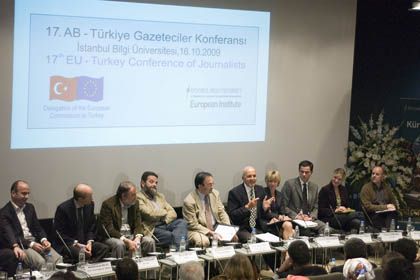
Kristin Ofer Finally this year’s EU Progress Report on Turkey was published on October 14th 2009 but instead of discussing the report’s details the journalists participating in the 17th annual EU-Turkey Conference of Journalists complained about the difficulties to keep people interested in the subject. Basically the message of the EU report was that there are slight progresses in Turkey but still some work has to be done. The European Commission expressed its appreciation of Turkey regarding the Ergenekon trial stating: “For the first time, illegal networks nested within the democratic institutions are being investigated.” Of course the diplomatic breakthrough between Turkey and Armenia when the foreign ministers of the two countries signed a protocol in Zurich on October 10th to improve their relation was positively mentioned as well. But the commission complained about the shortcomings concerning freedom of press and other civil rights like minority rights, especially for the Kurds, torture, excessive use of force by the Turkish security officials and women’s rights that still need to be improved. Surprisingly, the participants of the EU-Turkey Conference of Journalists which was held at Istanbul Bilgi University’s Santral campus, did hardly talk about these subjects. Instead of going into the details of the European Commission’s Report Professor Ayhan Kaya, Director of Bilgi University’s EU Institute and Moderator of the panel discussion, asked the European Journalists about the attitudes of their respective countries toward Turkey’s EU admission. The opening speech was delivered by Istanbul Bilgi University Rector Prof. Halil Guven who was rather critical of EU’s policies. He underlined the fact that EU has accepted “half of Cyprus as full member” while it failed to keep up with its promises for the remaining other half. Prof. Guven said, because of such policies it “is hard to defend EU in Turkey.” Following Prof. […]

Polonezkoy: Struggling to preserve its Polish identity

Aneta Rusak “Adampol is ending. It does not resemble the place which it was earlier. It is even hard to count how many Poles live here – approximately the number is 80. Many marriages are mixed and because of that sometimes the Polish culture is not being practiced. Usually children do not know the mother tongue nor the history of Poland,” complains Antoni Wilkoszewki, the muhtar or the headman of Polonezkoy, an interesting enclave of Polish culture located on the Anatolian side of Bosporus surrounded by forests of exceptional natural beauty. “Our customs are celebrated like they used to be. We still have a church with a Polish priest and also when something important is happening we are all getting together and discuss in the Polish language, we do not use Turkish. We are trying to protect our identity from dying,” said WiIlkoszewski. Polonezkoy – previously known as an Adampol – was established by Prince Adam Czartoryski (Chariman of the National Uprising Government and the leader of the Politicial Emigration Party) in 1842. During this period in history, Poland was divided into three and its territory was occupied by its neighbors, Austria, Prussia and Russia. Under the occupation the Polish population rebelled twice against the Russians in 1830 and 1863. These were called the November and January movements. The rebellion was mainly against Russia because it was the Russians who occupied most of Poland. Unfortunately, all of them failed. As a result Poland ceased to exist as an independent nation. Facing oppression and persecution, some of the Polish rebels were forced to emigrate from their country. Prince Czartoryski was one of them. He and his comrades found an asylum in Turkey, then the Ottoman Empire which supported Poles against the Russians. However, the court of Sultan Abdulmecid discreetly agreed to […]

AB’ye iki soru

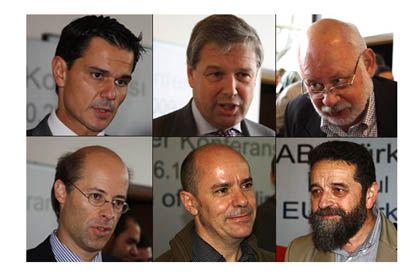
HaberVs*“Avrupa Birliği ve Türkiye İlişkilerinin Geleceği” paneli için bugün İstanbul’a gelen Avrupa Birliği üyesi altı ülkenin gazetecileri HaberVs’ye konuştu. Bu gazeteciler, Brüksel’deki Avrupa Parlamentosu’nda bağlı bulundukları gazete ya da haber ajansı adına çalışan yada AB haberlerini yakından takip eden isimlerdi. İçlerinde sadece Die Zeit gazetesi muhabiri Michael Thumann daha önce Türkiye’de görev yapmıştı. Muhabirlerimiz gazetecilere, panelde değinmedikleri iki konuda soru yöneltti. Bu sorulardan ilki, kendi ülkelerinde Türkiye’nin AB’ye girmesi konusunda kamuoyu desteği olup olmadığıydı. İkinci soru ise, 2004’te referandum sonrasında Kıbrıs sorunu hakkında görüşlerinin ne olduğuydu.*Özge Erel-Erim Hüner-Berk Doğan-Mert Oynargül-Niso Esim-Berk Doğan

La saison de la Turquie; triggers debate over Turkey in France

Manon Loisel Lots of Turkish newspapers rejoice at the fact that the Eiffel Tower was for five days, from 6 to 11 October, wearing the Turkish flag’s red and white colours. This was a wink at the “Saison de la Turquie”, which is currently taking place in France and will last for nine months. Whereas Turkish newspapers consider it a success, the French media hardly deal with it.For a few weeks now, posters of Aya Sofia and Bosporus are flooding the Parisian Metro; and not only in Paris but also in such cities as Lille, Marseille, Lyon, Strasbourg and Bordeaux. For nine months the “Turkish saison” celebrates Turkey’s culture through examples of contemporary art, architecture, photography, theater, dance, music and cinema at an estimated four hundred exhibitions.This event has been expected for a long time by lots of Turkish newspapers. On 10 September, the Turkish Daily News celebrated the successful start of The Saison by using lots of superlatives. But in France, the big newspapers, such as Le Monde, Le Figaro and Libération, chose to be either discreet or polemic. In an editorial by Ara Toranian, rather a militant spokesman for the Armenian diaspora in France, (Le Monde, 06/09/2009) he used the argument that no reference was made to the “Armenian genocide.” “Is Cultures France, the organizer, amnesic?” he was asking.Olivier Poivre d’Arvor, the director of Cultures France, the organizer of the event replied to Toranian describing his article “a little excessive and let’s say it, also intellectually dishonest.” The director mentions in his article that a series of discussions are taking place since September where taboos in the Turkish media are being discussed, including the Armenian question. He also points out that Ahmet Insel, one of the signatories of the letter asking for apology from the Armenians also took […]

Mikrofon taksicide

Mert Oynargül – Görkem Keser İstanbul’daki taksi şoförleri, 11 Ekim Pazar günü Çağlayan meydanında “korsan taksiye” karşı toplanarak seslerini Ankara’ya duyurmaya çalıştı. Sloganlarda ve kürsüden yapılan konuşmalarda hedef, kayıtlı taksilerin aksine vergi vermeden çalışan ve onların “ekmeğini çalan” kaçak taksilerdi. Meydandaki yaklaşık 2 bin şoför bir arada olmaktan ve sorunlarını haykırabilmekten mutlu görünse de, tek tek dinlendiğinde dertlerinin biteceğine dair çok da umut taşımadıkları anlaşılıyordu. Kürsüden meslektaşlarının hakkını savunan, korsan taksilerin hak ve emeklerini gasp ettiğini söyleyen hatta onlar için “namert, şerefsiz” gibi ifadeler kullanan Taksiciler Odası Başkanvekili Mustafa Silahyürekli’nin ağabeyinin bile kaçak taksi işlettiğinin ortaya çıkması bu umutsuzluğun nedenini ortaya koyuyordu. HaberVs, Çağlayan mitinginden sonra mikrofonunu İstanbul’daki taksi şoförlerine uzattı; korsan taksi ve diğer sorunların neden çözülemediğine dair görüşlerini aldı. “Emekli polisler kaçak çalışıyor” Mehmet Tekin (45): “Korsan taksi kullananların önemli bir bölümü polis emeklisi. Devlet, korsan taksiyle uğraşmıyor çünkü uğraşırsa karşısında yine kendini görecek. Polis, toplumun güvenliğinden sorumlu. Ama emekli olunca karnını doyuramıyor ve kanun dışı bu yola sapıyor. Ve görevdeki polislerden destek görüyorlar. Dahası uyardığımız korsan taksiler tarafından tehdit ediliyoruz. Yani hem canımız hem de malımız bu işten zarar görüyor.” Muammer Genç(52- Valideçeşme Taksi): “Oda bize sahip çıkmıyor. Kaçak durakların nerelerde olduğu belli. Ama ne oda ne polis ne de belediye bunların üzerine gitmiyor. Bizim oda hükümet ve belediyenin aldığı kararları imzalamak dışında başka hiçbir şey yapmıyor, tek işleri hükümet ne derse kabul etmek. Korsan taksi olsun, akaryakıt fiyatları olsun, yeni ücret tarifesi olsun. Taksiciler Odası’dan bir tane açıklama gördünüz mü? “Plakamdan iki tane var” Ali Bakırer: “Benim aracımın plakası çoğaltılmış. Devlet üç yıldır benim aracımla aynı plakayı taşıyan aracı bulamıyor. Evime sürekli ceza geliyor. Cezalara bakıyorum benimle alakası yok. Hakkımda şikayetler oluyor, karakolda şikayetçi olan insanlarla yüzleştiriliyorum, ‘Araç ve şahıs bu değildi’ diyorlar. Aracın ön farı ve ön çamurluğu kırılmış denilerek zabıt tutuluyor ama benim aracım […]

“Think or leave!” – Beuys and his students: an exhibition at Sabanci Museum

Karen Inge Schewina He is known for using fat and felt for his sculptures and performances, his political activity for the Green Party in Germany, the establishment of the “Free International University” and his charismatic speeches and lectures at the art academy in Düsseldorf.Curated by Friedhelm Hütte, Global Head of Art, Deutsche Bank, and art critic Ahu Antmen, On the occasion of the 100th year of Deutsche Bank’s presence in Turkey, Sabancı University Sakıp Sabancı Museum (SSM) presents an exhibition entitled “Joseph Beuys and His Students – Works from the Deutsche Bank Collection” from 9 September until 1 November 2009. It’s the first time after Beuys´ death in 1986 that his works on paper are shown together with prints, drawings and photographs done and taken by some of his most important students asPeter Angermann, Felix Droese, Imi Giese, Jörg Immendorff, Anselm Kiefer, Imi Knoebel, Blinky Palermo, Katharina Sieverding and Norbert Tadeusz. Beuys himself considered his teaching his “greatest work of art”. He believed in the creative potential every human being possesses, for him, every person was an artist, every action a work of art. “Art alone makes life possible,” he said in an interview “without art man is inconceivable in physiological terms.” Art was not supposed to be separated from life or presented in elite institutions, but the revolutionary power of art should transform society into a better place for everyone to live in. It may not have been his goal to produce eternal works; he wanted to make people think about their way of living and their option to take an active part in forming the so-called “social sculpture”.The exhibition shows in more than 300 examples how his students found to a way of expressing their feelings and perceptions of the world around them, being supported and guided by […]

Too many terminals, too short lines

Annika Sehn“Transportation of the Future is on its track with us.” That’s what Istanbul Ulaşım proclaims on the internet. Sounds very promising, at first glance. But can they keep their promise? With “Transportation of the future” they certainly don’t refer to the so far non-existent modern technique of the present situation in Istanbul’s public transportation system. More likely they mean the upcoming projects, which are under construction and planned at present, such as, for example, the Marmaray project, where a tunnel connecting the European and Asian side is being built or the extension from Shishane to Yenikapi, to provide better connections for the citizens of Istanbul. Over 13 Million people are living in Istanbul and they’re getting more populous every day. Surprisingly there are only two metro lines, four tram lines and one funicular, totalling hardly 50 km. Coming from Germany, I was very curious about how this works out. In Berlin there are nearly 330 km of metro and tram railway for only the quarter of the number of people living in Istanbul – and still you often have to squeeze in, during the rush hour. According to my experience in Berlin, I imagined the metro of Istanbul as highly overcrowded and overloaded. All the more surprising was my first encounter with the M2: going from Taksim to Shishane on a Sunday afternoon can make you feel pretty lonely, while walking through the deserted corridors, going escalator after escalator deeper underground. But in Taksim, some more people join in and it gets a little more crowded, while everybody is waiting for the next train going to 4. Levent. Everybody means, also the passenger continuing in the same direction from Shishane, which is another surprising fact. Going directly is – nobody knows why – impossible, which means another 10 minutes […]

Serenlere koruma müjdesi

Antalya- Elmalı’ya 11 kilometre uzaklıktaki Büyüksöğle köyünde bulunan tarihi arı kovanları “serenler” koruma altına alınıyor. Likya lahitlerine benzerliğiyle dikkat çeken ve yalnızca Antalya bölgesinde bulunan bu ilginç yapılar, gazeteci Yusuf Yavuz’un haberi ve halk kültürü araştırmacısı Öznur Tanal’ın başvurusu üzerine kültür mirası envanterine kazandırılıyor. İki yıl önce bölgede yaptığı çalışmayla serenlerin tarihi, mimari ve kültürel özelliklerini belgeleyen Antalya İl Kültür ve Turizm Müdürlüğü Halk Kültürü Araştırmacısı Öznur Tanal, Antalya Kültür ve Tabiat Varlıklarını Koruma Kurulu’na bir dilekçeyle başvurarak serenlerle ilgili yaptığı çalışmayı iletti. Dilekçesinde serenlerin koruma altına alınmasını talep eden Tanal’ın başvurusunu dikkate alan Koruma Kurulu eserleri yerinde inceledi. Konu, kurulun 28-29 Eylül 2009 tarihli toplantısında gündeme alındı ve serenlerin, kültür varlığı olarak tescillenip koruma altına alınmasına karar verildi. Kurul üyeleri aynı toplantıda, yine Büyüksöğle’de bulunan Sogla antik kentinin de tescillenerek koruma altına alınmasını kararlaştırdı. Şimdilik iki seren İlk aşamada Büyüksöğle köyündeki Avdancık mevkiinde bulunan iki adet serenin koruma altına alındığı bildirilirken, Korkuteli İmecik Susuzu ve Kumluca Dereköy’de bulunan serenlerin de kısa zaman içinde tescilleneceği öğrenildi. Koruma altına alınan Serenlerin çevresinde 27 ila 30 metrelik koruma alanı oluşturuluyor. Likya lahitlerine benzerliğiyle dikkat çeken ve sivil mimarinin şaşırtıcı örneklerinden biri olan Serenlerin tarihi 17. yüzyıla kadar uzanıyor. Elmalı’nın Büyüksöğle köyü dışında, Korkuteli İmecik Susuzu, Saklıkent Yazır Güzlesi, Kumluca Çakmak Yaylası ile Göldağı eteklerinde ve Beydağları’ndaki Ziyaret Tepesi eteklerinde son örnekleri bulunan serenler, arılar için bir çeşit sığınak işlevi görüyor.